
Why Fresh Milled Dough Behaves Differently
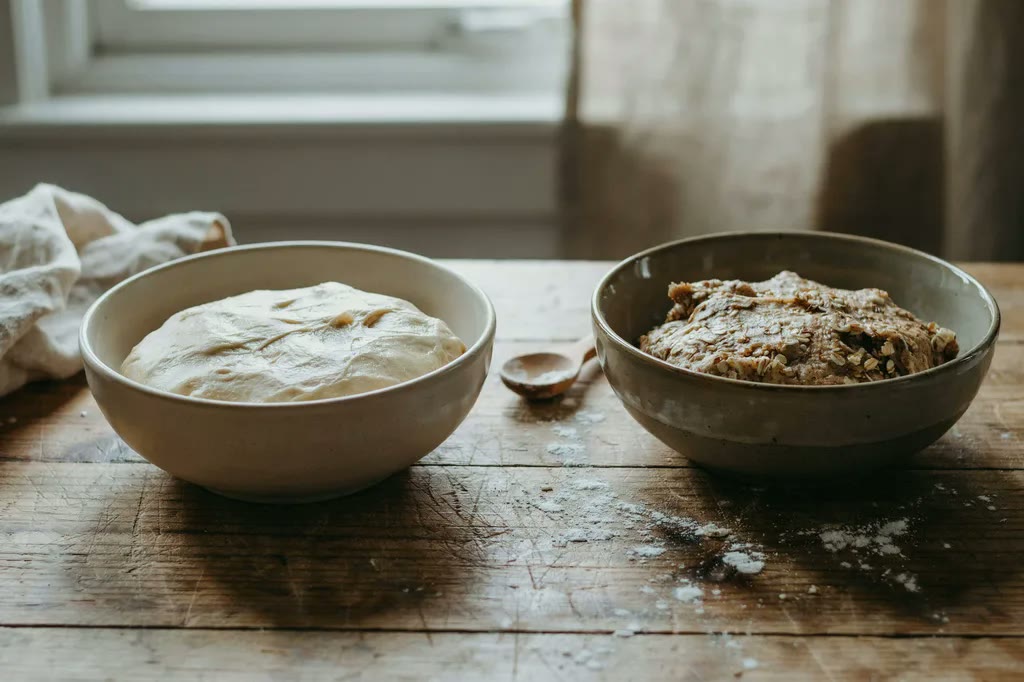
Fresh-milled dough behaves differently because it contains the bran, germ, and live enzymes that bagged flour has removed — the bran cuts the gluten network, the germ adds oils that soften the crumb, and the enzymes accelerate fermentation, so the dough hydrates differently, ferments faster, and develops strength more slowly than dough made from commercial white flour.
Key Takeaways
- Bran cuts the gluten network like tiny scissors, so doughs feel weaker and need gentler handling.
- The germ contains oils that soften crumb but shorten shelf life — bake what you mill.
- Live enzymes in fresh flour digest starch into sugar faster, accelerating fermentation by 20–40%.
- Whole-grain dough absorbs more water and more slowly than white-flour dough.
- Strength develops through long autolyses and gentle folds rather than aggressive kneading.
Summary
If you have ever followed a familiar bread recipe with fresh-milled flour and gotten a completely different result, the explanation is in the kernel. Commercial flour is essentially purified starch and gluten — the bran and germ are sifted out during industrial milling and the result is engineered for predictable performance. Fresh-milled flour is the whole kernel: bran on the outside, germ on the inside, endosperm in between. Each part contributes flavor and nutrition, but also changes how the dough hydrates, ferments, and develops. Understanding these four mechanics — bran, germ, water absorption, fermentation, and gluten development — turns fresh milling from a guessing game into a craft.
Steps
- 1
What is in a wheat kernel. Every wheat berry has three parts. The bran is the multilayer outer coat, roughly 14% of the kernel by weight, packed with fiber, B-vitamins, and minerals. The germ is the embryo at the base of the kernel, about 2.5% by weight, rich in vitamin E, healthy oils, and enzymes. The endosperm is the starchy interior, about 83% by weight, made mostly of starch granules and gluten-forming proteins. Commercial white flour is just the endosperm, milled and sifted. Fresh-milled whole-wheat flour is all three parts, in their natural proportions, freshly ground.
- 2
How bran changes dough. The bran is the biggest visible difference. Under a microscope, milled bran looks like sharp-edged flakes. When you mix dough, those flakes physically nick the strands of gluten that are forming, weakening the overall network. This is why a fresh-milled dough rarely produces the perfect translucent windowpane that a white-flour dough does — the network is simply more discontinuous. The practical effect: dough feels weaker, holds less air, and benefits from gentle handling rather than aggressive kneading. Long autolyses, stretch-and-folds, and patient shaping work better than the slap-and-fold approach used for high-protein white flour.
- 3
How the germ changes dough. The germ contributes flavor — nutty, slightly sweet, deeply aromatic — but also oils. Those oils soften the crumb (so fresh-milled bread is often more tender than expected) but also shorten the flavor window (germ lipase frees fatty acids and those oxidize, which is why milled flour is at its peak for 24–72 hours and merely usable for a week or two after that). A fresh-milled loaf tastes best on day one or two; by day four, you can taste a slight cardboard note as the oils oxidize. Freezing slices preserves the flavor far better than counter storage.
- 4
Water absorption and the slow drink. The bran is full of fiber and the germ is full of starches that bond with water more slowly than pure endosperm. When you mix a fresh-milled dough at a moderate hydration, the endosperm wets immediately and the bran is still thirsty an hour later. If you skip the autolyse, the bran continues to pull moisture from the crumb during baking and the loaf comes out dry. This is the single most important behavioral difference: fresh flour needs time and water that white flour does not.
- 5
Fermentation speed and enzyme activity. Wheat seeds carry their own enzymes — primarily amylases — that exist to digest starch when the seed sprouts. When you mill the berry, those enzymes mix into the flour. In a fresh-milled dough, amylases convert starch into sugar far faster than in aged white flour, which means yeast and sourdough cultures have more fuel and ferment more aggressively. Expect bulk fermentation to run 20–40% shorter than the same recipe in white flour. The dough also tends to overproof faster, which is the most common fresh-milled mistake.
- 6
Dough development through gentle work. Because the bran limits how much classical gluten you can build, the techniques that work best are gentle and patient. Autolyse — mixing flour and water, then resting 30 minutes to several hours before adding salt and starter — does much of the gluten development for you. Stretch-and-folds every 30 minutes for the first 90 minutes of bulk build strength without tearing the network. Coil folds during the second half of bulk preserve the air the dough has built. Aggressive kneading, by contrast, often makes fresh-milled dough feel worse, not better.
- 7
Shaping and oven spring. Fresh-milled dough is more extensible (stretches easily) and less elastic (does not snap back as much) than white-flour dough. Shape with a light hand: a quick pre-shape, a 15–20 minute bench rest, and a final shape with confident, single passes. Avoid over-tightening, which tears the surface and leaks gas. Oven spring tends to be more modest than with bread flour because the bran limits how high the dough can rise before the crust sets, but the flavor compensates.
- 8
Flavor that bagged flour cannot copy. The reason home bakers chase fresh-milled bread is the flavor. Volatile aroma compounds in the bran and germ — nutty, grassy, slightly sweet, occasionally floral — exist for days after milling and then dissipate. A bakery cannot mill at four in the morning, ship at six, sit on a shelf for three weeks, and deliver this flavor. Only home milling can. Once you taste the difference, the small technical adjustments described above stop feeling like work.
- 9
Putting it together. To work with fresh-milled flour successfully, accept three rules: hydrate more and wait, watch the dough not the clock, and handle it gently. The same recipe that took six hours in white flour might take four-and-a-half in fresh-milled. The crumb will be slightly denser but more flavorful. The crust will be browner. The aroma when the loaf comes out of the oven will explain everything.
Related Content
Related Grains
Spelt
An ancient hexaploid wheat with mellow flavor and easy hydration.
Einkorn
The oldest cultivated wheat, prized for digestibility and rich flavor.
Hard White Wheat
A milder, lighter whole wheat that bakes up tender and golden.
Hard Red Wheat
A high-protein modern wheat ideal for hearty whole-grain breads.
Rye
Fresh-milled rye delivers deep, tangy flavor and chewy crumb — a low-gluten grain that powers sourdough, dense sandwich loaves, crackers, and the classic breads of Northern Europe.
Related Recipes
Fresh-Milled Artisan Hearth Bread
A rustic Dutch-oven loaf made with 100% freshly milled hard red and hard white wheat. Open crumb, crackly crust, leavened with commercial yeast.
100% Whole Wheat Sandwich Bread
A soft, everyday sandwich loaf made with 100% freshly milled hard white wheat. Beginner-friendly and built for sandwiches and toast.
Beginner Fresh Milled Sandwich Bread
A soft, tall, freezer-friendly sandwich loaf made with 100% fresh milled hard white wheat.
100% Whole Wheat Sourdough
A deeply flavored sourdough loaf made entirely from fresh milled hard red wheat.