
Why Does My Bread Collapse?
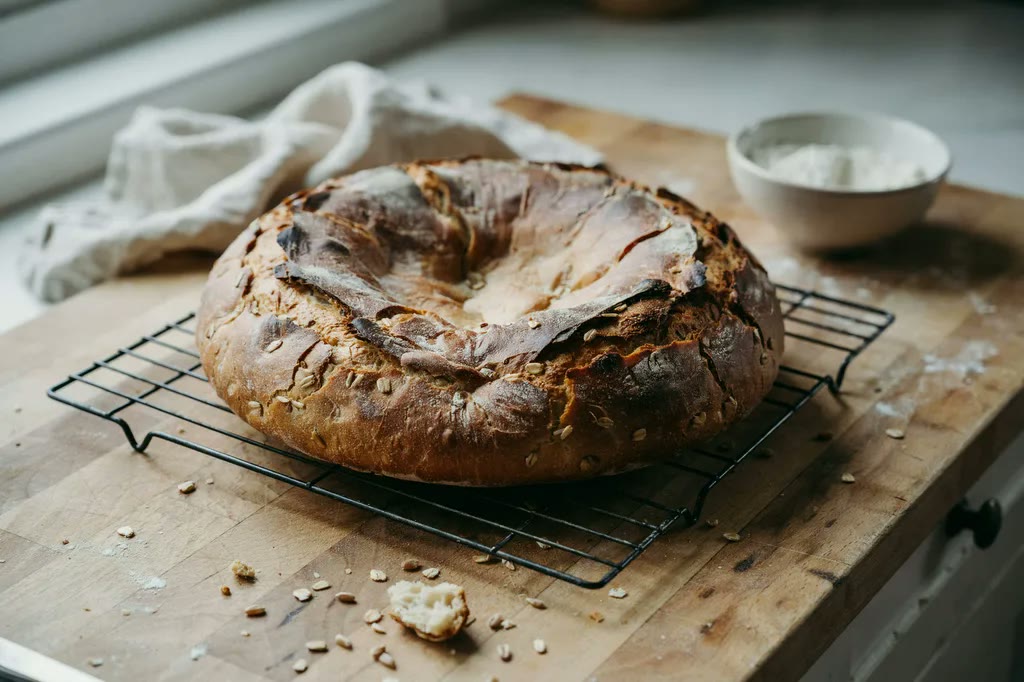
Bread collapses for four reasons: overproofing during the final rise, weak gluten that cannot hold the structure, hydration mismatched to the grain, or oven-spring failure where the crust sets before the dough has finished expanding — and each has a distinct visual signature.
Key Takeaways
- Overproofing is the most common cause — finger poke should spring back slowly, not stay dented.
- Weak gluten in fresh-milled bread is usually fixed by more autolyse and folds, not more kneading.
- Too much water for the gluten strength causes wide spreading and a sunken center.
- Oven-spring failure leaves a sharp inward fold near the top crust.
- One change per bake — diagnose by signature, fix one variable, observe the next loaf.
Summary
A collapsed loaf is the most disappointing failure in baking — the dough rose beautifully, the oven smelled right, and then the top sank into a wrinkled crater. The good news is that collapse has only four root causes and each leaves a different fingerprint. This guide walks through the diagnostic signs of each, explains what is happening inside the dough at the moment of collapse, and prescribes the specific fix for your next bake. The same four causes apply to sandwich bread, artisan boules, sourdough, and pizza crust.
Steps
- 1
## Cause 1 — overproofing. Signature: the loaf rises tall in the oven, then collapses in the last 15 minutes or as it cools, leaving a wrinkled or sunken top. The crumb is open but the texture is fragile and the bread tastes slightly sour or alcoholic. What is happening: the gluten network has been stretched to its absolute limit during the final proof, so when the oven heat hits, the structure expands once more and then collapses because there is no elasticity left. Fix: shorten the final proof by 20–30%. Use the finger-poke test — a gentle press should indent slowly and bounce back, not stay permanently dented. If your kitchen is over 75°F, proof in a cooler spot or reduce yeast/starter by 15%.
- 2
## Cause 2 — weak gluten. Signature: the loaf never rose much during bulk, came out short and squat, and the crumb is dense with a slightly damp feel even when fully baked. Sometimes the top has cracks rather than collapse. What is happening: the gluten network never developed enough strength to hold the gases produced during fermentation, so the dough leaked air the entire time. Fix for fresh-milled bread: extend the autolyse to 45–60 minutes, add a third or fourth stretch-and-fold during bulk, and confirm you are using hard wheat (white or red) rather than soft wheat. Vital wheat gluten can help while you build technique but is not a long-term solution.
- 3
## Cause 3 — hydration issues. Signature: the loaf is wider than tall, with a low dome or flat top, and the crumb is gummy or pasty in the center even after long baking. The dough was hard to shape because it spread on the bench. What is happening: the dough is over-hydrated for the gluten strength. The water cannot be held by the network, so the loaf spreads outward instead of rising upward. Fix: reduce hydration by 3–5% next bake. For fresh-milled, also confirm you actually have hard wheat — soft wheat at high hydration nearly always spreads.
- 4
## Cause 4 — oven-spring failure. Signature: the loaf shows a sharp inward fold near the top crust, almost like a step or shelf, and the bottom half rose normally. The crust looks pale where it folded. What is happening: the crust set on the outside before the inside finished expanding, so when steam continued to build, the top buckled. Causes are oven too hot too early, not enough steam at the start (steam delays crust formation), or insufficient slashing (the slash gives a controlled escape path). Fix: add steam for the first 15 minutes (a Dutch oven with lid, or a metal pan of boiling water on a lower rack), score the loaf with a confident half-inch deep slash, and consider reducing the initial oven temperature by 25°F for the first 15 minutes.
- 5
## Sourdough-specific collapse. Sourdough loaves collapse for the same four reasons, with two additions. First, an under-fermented starter cannot produce enough gas, so the loaf may look fine until the oven and then sink (use a starter that has at least doubled in 4–6 hours since last feeding). Second, an over-acidified dough breaks down its own gluten — the longer your bulk runs at warm room temperature, the more acid accumulates, and past a point the gluten dissolves. Fix sourdough collapse by feeding the starter twice the day before baking and watching bulk to 60–80% volume growth rather than a fixed time.
- 6
## Sandwich-bread-specific collapse. Pan loaves collapse in pans for two specific reasons: overproofed in the pan (dough rises above the rim, then implodes during oven spring), or pulled too early from the pan (the loaf has not set internally, so the sides cave in once the pan is removed). Fixes: proof in the pan only until the dome rises just above the rim and a gentle finger press leaves a slow-bouncing indent. Cool the loaf in the pan for 10 minutes, then transfer to a wire rack to finish cooling. Never remove from the pan when it is still hot enough to feel uncomfortable in bare hands.
- 7
## Diagnosing your specific collapse. Look at the loaf and match: wrinkled or sunken top with sour flavor → overproofing. Short, squat, dense → weak gluten. Wide, flat, gummy center → over-hydration. Sharp inward fold near the top with pale crust at the fold → oven-spring failure. If you see more than one signature, fix them in this order on successive bakes: hydration, then fermentation timing, then gluten development, then oven setup. One change per bake gives you a clean diagnosis.
- 8
## Prevention checklist. Before every bake: weigh all ingredients in grams; mix flour and water and rest 30 minutes before adding salt and starter; complete enough folds during bulk that the dough feels strong and bouncy; check final proof with the finger-poke test; preheat the oven fully with the baking vessel inside; score with confidence; cool fully on a wire rack before slicing. Following the checklist eliminates roughly 80% of collapses.
Related Content
Related Grains
Related Recipes
Fresh-Milled Sourdough Boule
A high-hydration, 100% fresh-milled sourdough boule with an open crumb, deep flavor, and a crackly crust — built around an autolyse and four sets of stretch-and-folds.
Fresh-Milled Artisan Hearth Bread
A rustic Dutch-oven loaf made with 100% freshly milled hard red and hard white wheat. Open crumb, crackly crust, leavened with commercial yeast.
Beginner Fresh Milled Sandwich Bread
A soft, tall, freezer-friendly sandwich loaf made with 100% fresh milled hard white wheat.
Honey Wheat Bread
Baking with freshly milled hard white wheat flour transforms an everyday recipe into something extraordinary. Within minutes of milling, whole-grain flour is bursting with natural oils and a sweet wheaty aroma — the part that fades first once flour sits — and it still carries the whole berry: bran, germ, and endosperm. Commercial white flour has the bran and germ removed and is stabilized for months of shelf life — fresh milling skips all of that, so you bake with the whole grain and with the aroma still in it. This honey wheat bread is the perfect entry point for new fresh-milled flour bakers. Hard white wheat is naturally mild, sweet, and lighter in color than hard red wheat, which makes it a forgiving choice for sandwich loaves. Honey adds tenderness, a touch of caramel sweetness, and helps the bread stay soft for days. Because fresh-milled flour absorbs water more slowly than store-bought flour, this recipe uses a generous autolyse rest so the bran can fully hydrate before kneading — the difference in crumb tenderness is dramatic. If this is your first whole-wheat loaf, plan to bake it on a quiet morning. Fresh-milled doughs feel a little tackier than white flour doughs at first; resist the urge to add more flour. After the autolyse you'll find it transforms into a smooth, supple dough that's easy to shape. Bake it once at the listed hydration before adjusting — the formula is dialed in for whole hard white wheat at room-temperature water.
100% Whole Wheat Sourdough
A deeply flavored sourdough loaf made entirely from fresh milled hard red wheat.